
Let’s Talk About Baby’s Position
Because head down is only part of the story
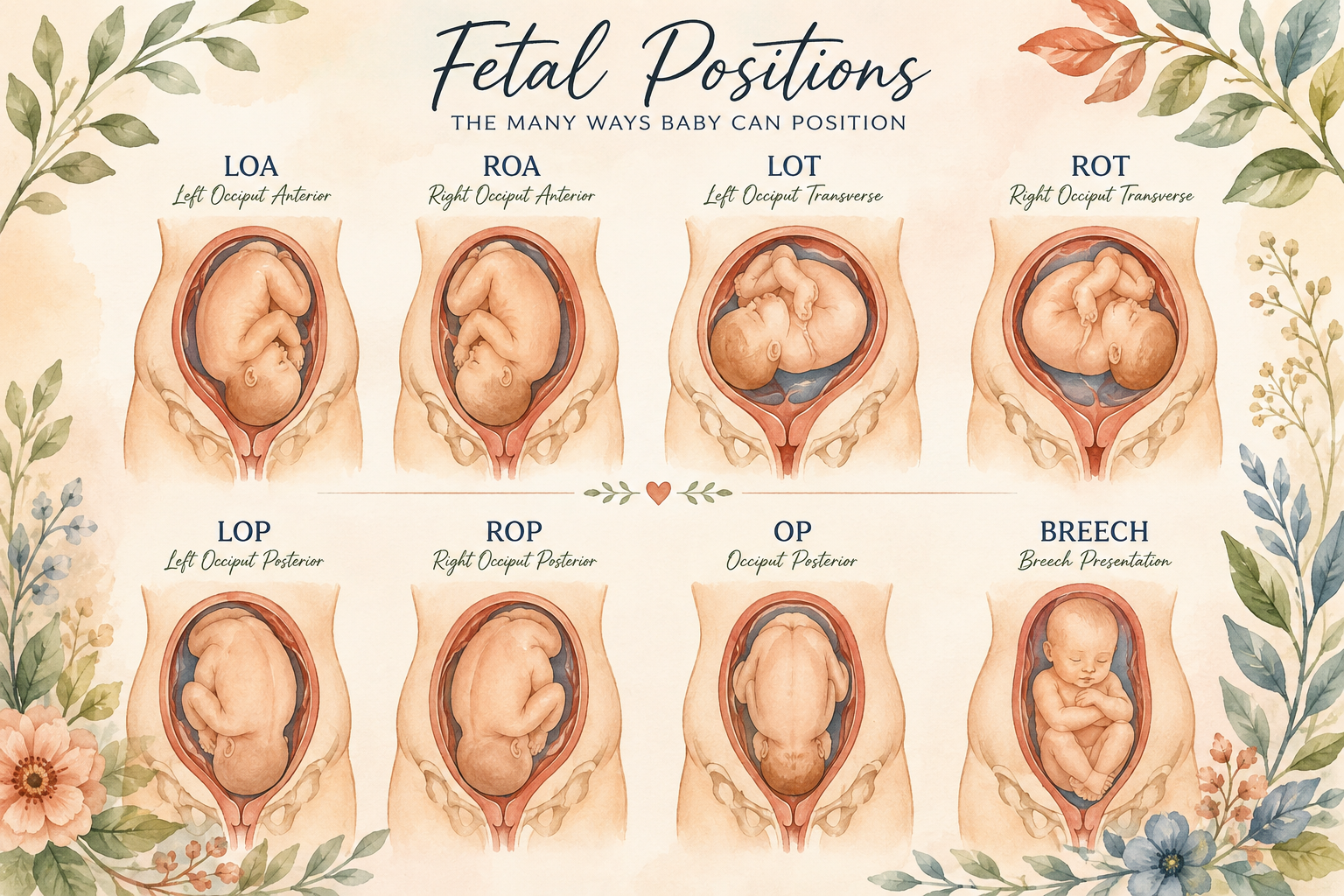
LOA, ROA, ROT, LOT, OP, LOP, ROP, breech…. oh my!
Okay, let’s take a breath. Inhale... exhale...
Where is this baby, and what does any of this mean?
These babies can have a mind of their own. But our babies and bodies are also pretty intelligent. So let’s jump into what all of these positions mean, why we care about them, and some things you can do to encourage baby into a good position for birth.
Head Down... But Where Is Baby Looking?
“Head down” is typically what most women, and honestly some providers, seem to be most concerned about.
But there is so much more to it!
Once baby is head down, we can also talk about which direction baby is facing and where their back is positioned in relation to your pelvis.
I am a lover of Spinning Babies, so you'll hear some of their philosophy woven into how I talk about positioning. I highly recommend checking out their resources if you want to learn more about fetal positioning, belly mapping, and maternal movement during pregnancy and labor.
When you see your midwife, they will most likely start doing something called Leopold's maneuvers once baby is a little bigger, often somewhere around the third trimester.
This is when you see us feeling around your belly trying to answer all of our questions.
Where is the head? Where is the bottom? Where is the back? How low is baby? How high is baby? What on earth is this little lump I'm feeling over here?
We are basically trying to map your baby from the outside.
And yes, I love a good LOA. Every midwife does.
But some babies do not care what I love.
Little stinkers.
LOA and ROA
LOA means Left Occiput Anterior.
In normal-person language, baby is head down, with the back of baby's head toward the left-front side of mom's pelvis and baby's back generally along mom's left side.
This is often considered a very favorable position for labor because it can allow baby to navigate the curves of the pelvis nicely.
But what if baby is ROA?
Right Occiput Anterior.
Same basic idea, but baby is hanging out more toward mom's right side.
Are we panicking?
Nope!
ROA can also be a perfectly workable position for labor. And here's something really important to remember throughout this entire conversation: babies move.
The position your baby is in at your prenatal appointment is not necessarily the position they will be in when labor begins, and babies continue rotating and adjusting as they move through the pelvis during labor.
So please don't go home from your appointment thinking, “MY BABY IS ROA! EVERYTHING IS RUINED!”
It's not.
What About ROT and LOT?
Sometimes baby's back is more toward your side.
ROT means Right Occiput Transverse and LOT means Left Occiput Transverse.
These babies are basically hanging out sideways while still being head down.
You may hear your midwife talk about encouraging movement or positioning to give baby plenty of room to rotate and descend.
And this is where I really like movement.
Walking, changing positions, getting off the couch, using a birth ball, moving your hips, and generally giving your pelvis opportunities to move can all be useful. During labor, frequent position changes can also be great for comfort and may help baby find their way through the pelvis.
Sometimes babies just need a little room to figure things out.
OP, LOP and ROP... Hello, Back Labor
Then we have posterior babies.
OP means Occiput Posterior. LOP and ROP tell us whether baby is positioned more toward mom's left or right while facing toward her front, leaving baby's back closer to mom's back.
This is where you may have heard the infamous words...
Back labor.
Posterior does not automatically mean something is wrong, and it doesn't mean baby cannot be born vaginally. Babies can rotate during labor, and sometimes a posterior position is simply part of how that particular baby navigates that particular pelvis.
But posterior positions can sometimes be associated with more back discomfort or a longer labor.
This is where movement and position changes can become really helpful.
I often point families toward Spinning Babies techniques, and depending on the individual situation, some women also choose to work with pelvic floor physical therapy or other supportive providers during pregnancy.
The goal isn't to bully baby into the position we have decided is “perfect.”
We're trying to create space and support movement.
And Then There's Breech...
Dun dun dun!
Breech means baby's head is up instead of down. Depending on the type of breech presentation, baby's bottom, feet, or both may be closest to the cervix.
First of all, if your baby is breech earlier in pregnancy, breathe.
Babies move around a lot, and many will turn head down on their own before term.
When baby remains breech later in pregnancy, though, that's when we start having more conversations.
Why is baby breech?
Sometimes we know there may be a contributing factor. And sometimes?
We don't know.
Baby just chose breech.
I personally like to start talking more seriously about positioning and options as we get into those later weeks. Some families explore movement and positioning techniques and may also choose supportive care such as pelvic floor therapy, prenatal massage, acupuncture, or chiropractic care.
The important thing is that we're not trying to force anything.
We're looking at the whole picture, giving baby opportunities to move, and continuing to reassess.
If baby is still breech as we approach term, another option may be a consultation with an OB/GYN to discuss an external cephalic version, or ECV.
An ECV is a procedure where an obstetric provider attempts to turn baby from the outside of your abdomen while you and baby are closely monitored. It isn't appropriate for everyone, it isn't always successful, and it has risks and benefits that deserve an actual conversation with the provider performing it.
And what about vaginal breech birth?
This is where things get complicated.
There are providers with specialized training and experience in vaginal breech birth, although finding one can be difficult depending on where you live and your individual circumstances.
If this is something you are interested in exploring, do your research and have detailed conversations with appropriately trained providers about your individual risks, benefits, and options.
Breech Without Borders is one resource I recommend for families who want to learn more.
So... Where Is Your Baby?
Your baby has a lot of positioning options!
And I think one of the most important things to remember is that fetal position is not a grade on your pregnancy.
You did not “fail” because your baby is posterior.
You did not do something wrong because your baby prefers your right side.
And you don't need to spend your entire third trimester obsessively trying to achieve the perfect LOA baby.
Learn about your body.
Learn about your baby.
Try belly mapping. Move your body. Give your pelvis opportunities to move. Ask your midwife what they're feeling when they do Leopold's instead of just letting us poke around your belly in silence!
And remember that babies are active participants in birth, too.
Sometimes they're saying, “Hey! I need a little more room over here.”
And sometimes they're saying, “Hmm... my head fits pretty well like this. Leave me be!”
Our job isn't always to dictate exactly where baby should be.
Sometimes it's simply to create space, pay attention, and let baby find their way.
If you want to nerd out about fetal positioning after this Coffee Chat, Spinning Babies has tons of resources on fetal position, belly mapping, pregnancy movement, and labor positions.
And if you're navigating a breech pregnancy and want to understand more about your options, Breech Without Borders also has educational resources for parents.
Happy baby mapping!
